
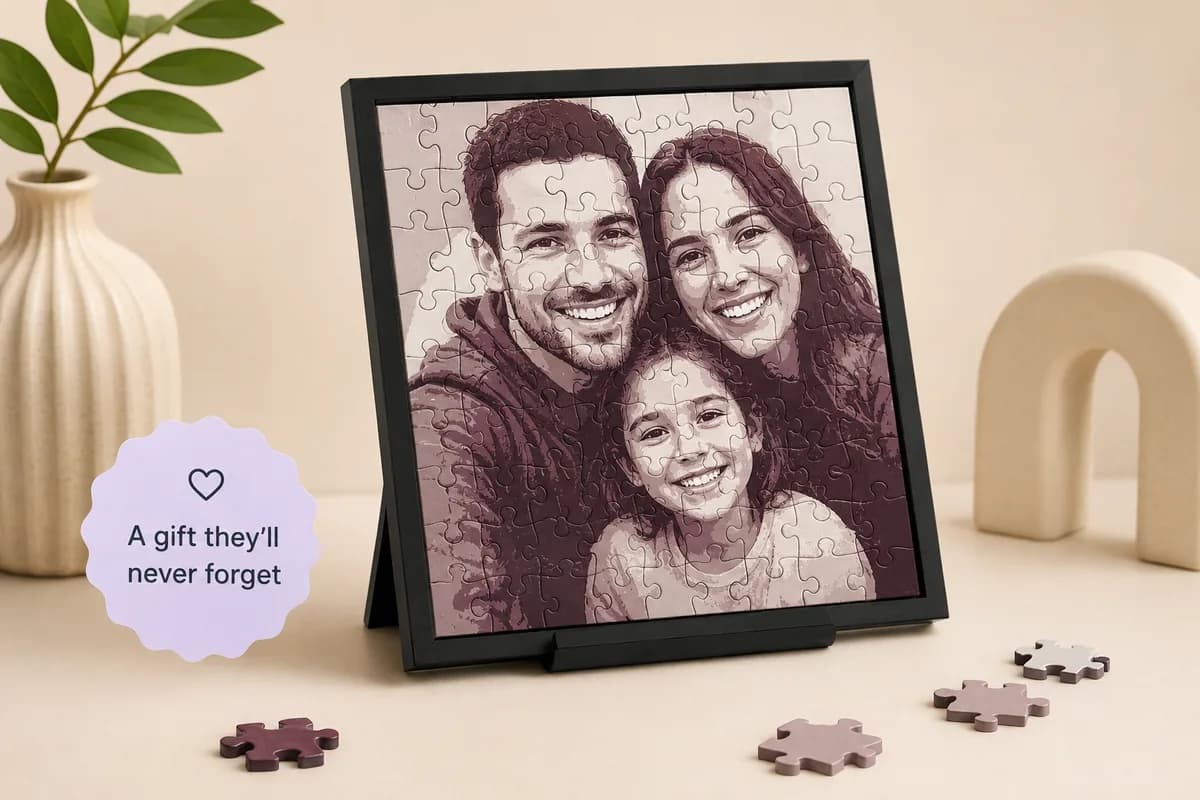
The question we get most often in December is not about colours or slicers. It is “will I make it in time?” The honest answer is that a photo puzzle is a slow print compared with the usual MakerWorld fare, because the image is built from 0.08 mm layers and a 250 mm print has a lot of surface to cover at that resolution. A Large puzzle is an overnight job, not a lunch break.
The good news: the times are predictable. Below are our measurements, then a schedule that gets five gifts out of one printer with a week to spare.
Print times by size
Measured on a Bambu Lab P1S with four filament colours, Balanced preset, no frame. Every photo is different (aspect ratio, how much of the image is bright, how many colour changes per layer), so treat these as averages with about 30% spread either way.
| Size | Long side | Pieces | Print time | Filament | Fits an evening? |
|---|---|---|---|---|---|
| Mini | 100 mm | ~56 | ~2 h | ~15 g | Yes, two in a row |
| Small | 140 mm | ~80 | ~4 h | ~25 g | Yes |
| Medium | 180 mm | ~143 | ~6.5 h | ~40 g | Start before dinner |
| Large | 210 mm | ~180 | ~8.5 h | ~55 g | Overnight |
| Ultra | 250 mm | ~304 | ~12 h | ~80 g | Overnight, check in the morning |
Add about 2 hours for the display frame with a stand. The Fast preset cuts roughly a third off, at the cost of some surface quality on the light tones; Quality adds a little. On an A1 mini the small sizes come in under 3 hours. Filament cost is trivial: even an Ultra puzzle uses about two dollars of PLA.
What makes a puzzle slower (or faster)
- Pieces: more cuts mean more travel moves, but it matters less than you would think. Choose the piece count for the person, not for the clock.
- Colours: in these files each colour is a band of layers, so a four-colour puzzle has exactly three filament changes in the whole print. Colour count barely moves the time; two colours still looks great for old black-and-white photos, it just is not faster.
- Bright photos: bright areas are taller, so a snowy landscape prints longer than a dark portrait.
- The frame: about two hours, printed from the same project file. Skip it if the puzzle goes on the fridge with magnets.
- Bigger than the bed: the generator splits oversize puzzles across several plates with dovetail joints. Each plate is its own print, so a 50 cm panel is two or three Large-sized jobs.
The schedule: five gifts before 24 December
Assume one printer, evenings only, and that you want a safety margin. Count backwards from the day the gifts need to be wrapped (or posted).
- Before you start: generate the puzzle and look at the preview for a minute. The preview is what the print will look like; if the face is muddy there, it will be muddy in plastic. Fix the contrast now, not after eight hours.
- Evening 1, test: print a Mini (2 h) of your most important photo with the spools you own. Check the likeness and the colours under a lamp. This is the evening most people skip, and the one that saves the others.
- Evenings 2 to 4: one Large or Medium gift per night, started before dinner and finished by morning. If one fails or lifts off the plate, you have lost a night, not the week.
- Evening 5: small prints in one go: Minis, soundwave plaques, ornaments. Two Minis back to back fit in one evening.
- Evening 6: frames. Two frames fit in one night. Assemble, test the stand, wrap.
- Keep one spare evening. Every year somebody runs out of white filament on 22 December.
That is six evenings for five gifts. Starting on 10 December is comfortable; starting on 20 December means printing through the night and skipping the test, which is exactly how puzzles end up with a face nobody recognises.
Mailing a printed gift
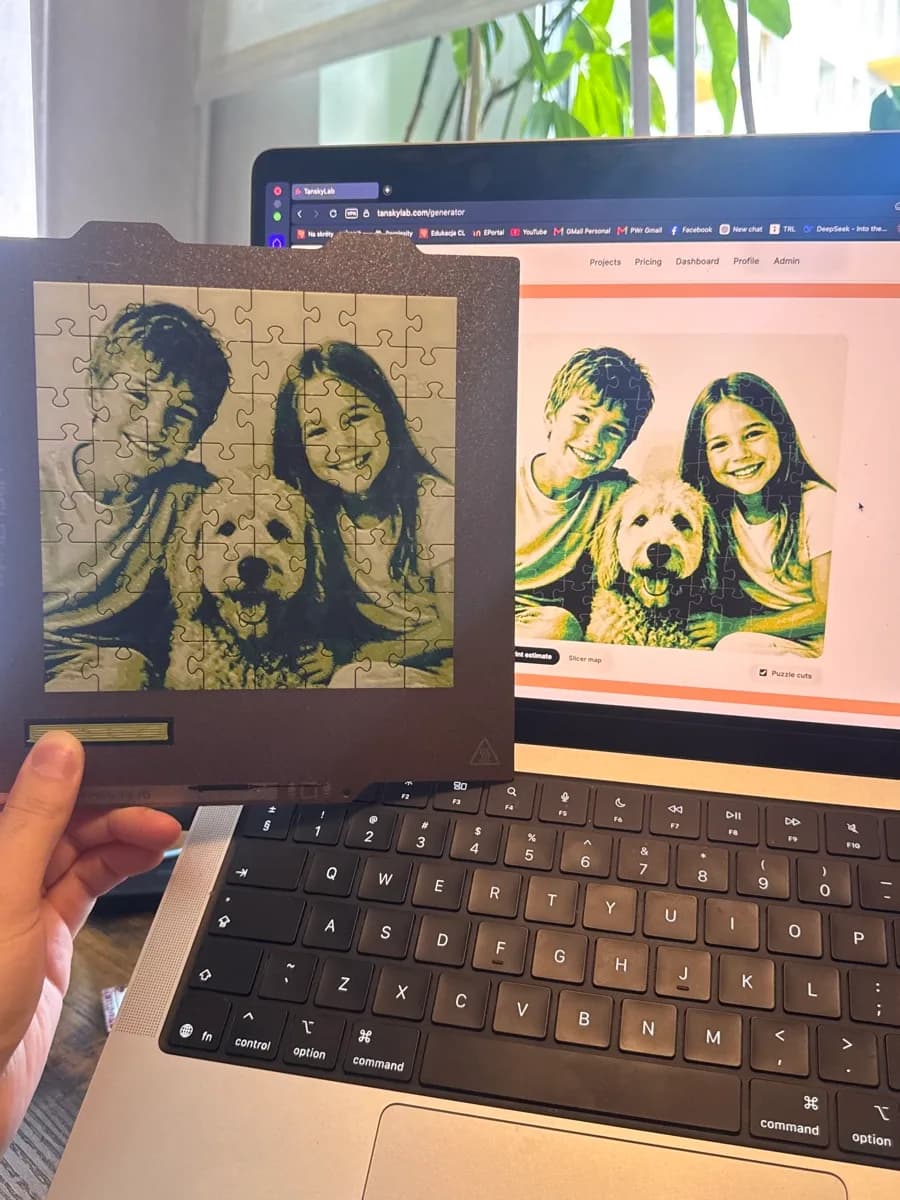
Puzzles travel well disassembled. Put the pieces in a zip bag, print the frame separately and pack it flat, and add a photo of the assembled puzzle so the recipient knows what they are building. Allow a week for domestic post in December and two for anything crossing a border. If the puzzle ships assembled, the Photo Box sized to the puzzle is the sturdiest packaging you can print.
If a piece goes missing on Christmas Day
It happens, usually under the sofa. With Premium you can open the project in your dashboard, tap the missing piece and print only that one. The generator keeps the relief map for twelve months, so the replacement matches exactly. Two free generations a month cover the test and the real print; the Premium plan covers unlimited generations and the single-piece reprint.